
MindAhead Active:
Digital Therapy for MCI and Mild Dementia.


Behavioral Activation to slow down cognitive decline
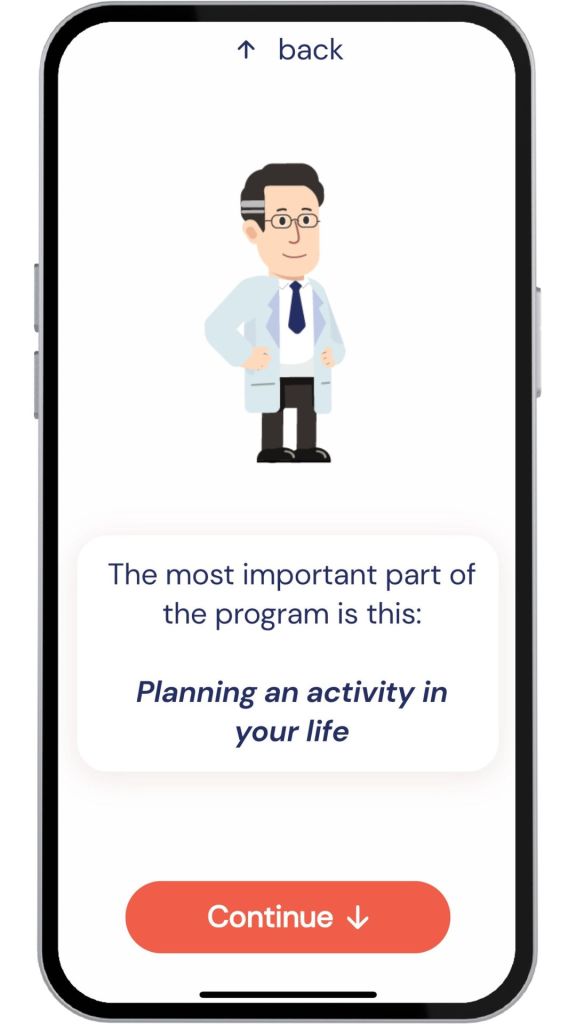
The MindAhead Active app runs on mobile devices to deliver personalised behavioral activation therapy. MindAhead Active is a class I medical device (MDR) can be used by patients independently.

Specifically designed for population 60+
The app is specifically designed for people with mild cognitive impairment and early dementia. Simple controls, large font size and visual support help users to navigate the app. Only basic smartphone skills are required.
At each stage of the development, people affected by MCI and mild dementia were involved to make sure the app meets their needs.
Supported by clinical research
Clinical research by Rovner et al. has shown that behavioral activation therapy can significantly reduce memory decline in MCI .
“We found that after 2 years, participants in the behavioral activation group were only half as likely to show deterioration in cognitive tests at a given time point.” – Dr. Barry Rovner

A novel digital treatment
You cannot cure dementia. But you can slow it down.
Behavioral activation therapy stimulates the brain in three important areas: social, physical, cognitive. This can slow down cognitive decline and help stay independent for longer.
“There is no other digital therapy that uses the behavioral activation approach for dementia. It is a unique approach designed to give back some degree of control over the rate of cognitive decline.” – Patrick Fissler, PhD

The Scientists behind MindAhead

Seth A. Gale, MD
Co-Director, Brain Health Program, Division of Cognitive and Behavioral Neurology at Brigham and Women’s Hospital
Assistant Professor of Neurology, Harvard Medical School

Robert Brady, PhD
Robert Brady is an expert in Behavioral Activation and teaches and researches at Dartmouth College.


Dr. Patrick Fissler

Dr. Dipl.- Psych. Olivia Küster
Dr. Olivia Küster is a cognitive neuroscientist focused on aging, memory, and cognitive resilience. Her research explores neural and lifestyle factors that promote healthy aging and delay cognitive decline.
Supported by:


